 Snagline
New build snagging: what happens, when, and how to get snags fixed
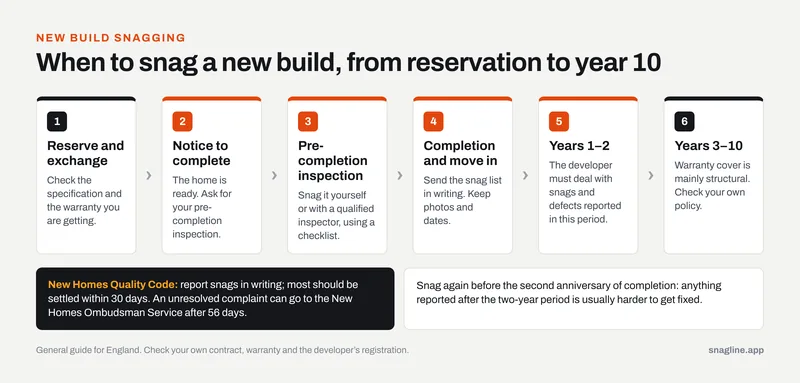
New build snagging means inspecting a newly built home for faults in finish and fitting, listing them and getting the developer to fix them. In the UK it runs in four rounds: a pre-completion inspection after notice to complete, a check at handover, reporting as snags appear during the developer's two-year period, and a final walk-round before the second anniversary of completion.

What new build snagging covers
Snagging on a new build is the whole process, not just the inspection: find the faults, write them down, send them to the developer, give trades access, check the repairs and keep chasing until every item is closed. A snag is usually small and visible (a paint run, a door that catches, a gap in sealant). A defect can be more serious and may only show with time or weather (a leak, missing insulation, a cracked lintel). You report both the same way. For the definitions and the difference between them, see what is snagging.
This guide is for two groups. Buyers of new homes, who want to know what to do and when. And the people on the other side: site managers, customer care teams and trades who receive snag lists and have to close them out. Both sides do better with the same thing: a clear, numbered list with a location and a photo for every item.
If you want the room-by-room list to walk round with, use the new build snagging checklist (Word, Excel and PDF versions are in the download box above). This page is about the process around it.
When to snag a new build: the four rounds
1. Pre-completion inspection
If your developer is registered with the New Homes Quality Board, the New Homes Quality Code gives you the right to a pre-completion inspection. It normally takes place after the developer has served notice to complete and before legal completion (earlier if you both agree). You can do it yourself or appoint a suitably qualified inspector, and it uses the New Homes Quality Board's standard Pre-Completion Inspection Checklist. This is the best moment to snag: the trades are still on site, the rooms are empty and nothing is hidden behind furniture.
Where the inspection finds issues that breach the warranty provider's technical standards, the Code says the developer is responsible for addressing them, ideally before legal completion, or within 30 days if that is not possible. The inspection is not meant to delay completion, so do not treat it as a chance to renegotiate.
2. Completion and handover
At handover the site manager or customer care team usually walks you round, shows you the heating, the stopcock and the consumer unit, and takes meter readings. Check that items from your pre-completion list have been fixed, note anything new and make sure you have the warranty documents and the developer's written after-sales procedure.
3. The first months and the two-year period
Some snags only appear once you live in the home: a shower that leaks into the ceiling below, cold radiators, doors that stick once the heating dries the timber, small cracks as plaster shrinks. Under the Code the developer is responsible for dealing with snags and defects that arise in the first two years after completion. Report each one in writing as soon as you notice it. Many buyers send a first post-move list after a few weeks and then report items as they come.
4. Before the second anniversary
Diarise a full walk-round about two months before the second anniversary of completion. After two years most warranties move to a narrower, mainly structural cover, and cosmetic snags are unlikely to be covered by anyone. Report everything still outstanding, in writing, before the date.
DIY snagging or a professional inspector?
Both work. The choice comes down to your knowledge, your time and the size of the home.
| DIY snagging | Professional inspector | |
|---|---|---|
| Cost | Free | A fee that varies with home size and region |
| Checks | Finish and function: paint, doors, taps, sockets | Finish plus building regulations and warranty technical standards |
| Likely to find | Visible snags | Visible snags plus less obvious items: loft insulation, roof details, ventilation |
| Report | Your own list | A written report to send to the developer |
| Under the Code | Allowed, using the standard checklist | Must belong to a recognised professional body and hold indemnity insurance |
A sensible combination for many buyers is a professional pre-completion inspection, then your own lists once you have moved in. For what a professional survey includes, who can carry one out and what it costs, see snagging survey.
If you do it yourself: go in daylight, allow two to three hours for a typical house, take a torch, spirit level, socket tester and a charged phone, and work from top to bottom in each room. The New Homes Quality Board's checklist guidance includes inspecting internal walls in natural daylight from at least two metres away, without shining a light along the surface, so do not report every shadow a torch shows up.
The most common new build snags, by area
These are the faults that come up again and again. Use them to know where to look; the checklist has the full room-by-room list.
Outside
- Mortar smears and paint splashes on brickwork; gaps in mortar under sills and around frames.
- Air bricks blocked by soil or paving; damp proof course bridged by a path or flower bed.
- Gutters not falling to the downpipe; downpipes discharging onto paths.
- Paving that falls towards the house, rocking slabs, standing water by doors.
- Building rubble just under the turf; fences that do not match the plot plan.
Walls, ceilings and woodwork
- Patchy paint, paint runs and paint on sockets, switches and glass.
- Nail pops and hairline cracks in plasterboard, often at ceiling joints.
- Open mitres on skirting and architraves, missing caulk, unpainted top edges of doors.
Doors and windows
- Internal doors that catch, do not latch or have uneven gaps.
- Windows that do not lock, missing keys, scratched or misted glazing, missing trickle vents.
- Draughts and daylight around front and patio doors.
Kitchens and bathrooms
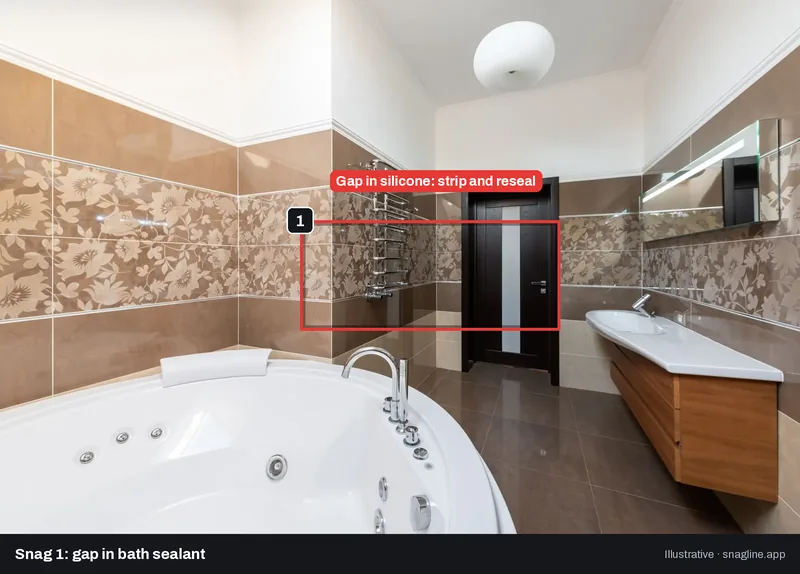
- Gaps or smears in sealant around baths, shower trays and worktops.
- Chipped worktops and unit doors out of line.
- Cracked or uneven tiles and incomplete grout.
- Slow drains, dripping taps and leaks under basins.
- Extractor fans that run but are not ducted outside.
Loft and services
- Insulation missing at the eaves or around the hatch, or squashed by boarding.
- Extractor ducts loose in the loft instead of connected to a vent.
- Radiators that stay cold, unlabelled consumer units, missing commissioning paperwork.
How to report snags to the developer
How you report matters as much as what you find. A clear list gets fixed faster and gives you a record if things go wrong.
- Use the official channel. Send snags through the developer's after-sales portal, email address or form, as set out in their written after-sales procedure. A word with someone on site is not a report.
- One numbered list. Each item gets a number, a room, an exact location, what is wrong and a photo. "7. Bathroom: sealant missing at tap end of bath, about 20 cm, photo 7." Our guide to writing a snag list has more examples, and the snag list template in the download box above has the columns ready.
- Two photos per snag. One wide to show where it is, one close to show what is wrong.
- Keep the date and reference. Note when you sent the list and any case number you get back. The Code's 30-day timings run from when you report.
- Agree access in writing. Confirm appointments by email. On the day, note who came, what they did and what is still open.
- Re-issue the list, do not start a new one. Keep the numbers, mark items Fixed or Still open, and send the updated version.
For developers and contractors on the receiving end, the same discipline works in reverse: acknowledge the list, give each item an owner and a target date, photograph the repair and send the buyer an updated list showing what is closed. It is the fastest way to stop a snag turning into a complaint.
How long does the developer have to fix snags?
Under the New Homes Quality Code a developer should, in most situations, resolve an after-sales issue within 30 days of it being reported. If there is a delay, it must explain why and keep you updated at least once a month. A snag is not automatically a complaint, but if it is not put right within 30 days of reporting you can ask for it to be handled under the developer's formal complaints procedure.
Emergencies are different. A total loss of heating or water, an unsafe electrical fault or a serious leak should go to the developer's emergency contact straight away, not onto a snag list.
If the developer is not registered with the Code, look at your contract, the developer's own customer charter and your warranty provider's terms. NHBC's Buildmark, for example, says that in the first two years the builder must put right defects that breach NHBC's requirements, with NHBC offering a resolution service if you cannot agree. Other warranties, such as Premier Guarantee and LABC Warranty, have their own terms: check your own policy.
What if the developer won't fix the snags?
- Chase in writing. Refer to your list, item numbers and the dates you reported them.
- Make a formal complaint. Use the developer's complaints procedure. Under the Code the developer should send you a Complaint Assessment and Response Letter within 30 days and, if the complaint is still open, an Eight-Week Letter no later than 56 days, explaining what is outstanding and how to go to the Ombudsman.
- Refer to the New Homes Ombudsman Service. For developers registered with the Code, a complaint about an issue that arose within the first two years can be referred to the Ombudsman once 56 days have passed since the complaint start date. The Ombudsman's scheme rules set its own time limits, so check them on its website and do not sit on a complaint.
- Use the warranty's resolution service. Your warranty provider may offer dispute resolution for defects in the builder warranty period.
- Take advice. For serious defects or large sums, get independent legal or surveying advice before acting.
At every step, your evidence is the numbered list, the photos and the dates. Buyers with a tidy record have far easier conversations than buyers relying on memory.
Common mistakes
- Skipping the pre-completion inspection because completion is close. It is the cheapest time to get things fixed.
- Snagging at dusk or by torchlight, which hides some faults and exaggerates others.
- Reporting verbally to the site team instead of in writing to after-sales.
- Sending a new list each time with different numbers, so nobody can tell what is still open.
- Letting the second anniversary pass with items still outstanding.
- Making alterations (new flooring, drilling into tiled walls) before related snags are fixed, which muddies who is responsible.
Keeping the snag list on a phone
Snagline is a phone app we are building for snag lists and site audits, iPhone first. Each snag gets a number, photos you can mark up with arrows and circles, a location, a priority and a status (Open, In progress, Fixed, Closed), and the list becomes a PDF report to send to the developer. It is not released yet; the waitlist is below.
Questions
When should you do snagging on a new build?
Ideally at a pre-completion inspection after notice to complete, then at handover, then as snags appear during the developer's two-year period, with a final check before the second anniversary of completion.
Can I snag my new home myself?
Yes. Under the New Homes Quality Code you can carry out the pre-completion inspection yourself using the standard checklist. Go in daylight, allow two to three hours for a house and photograph every item.
How long does a developer have to fix snags?
Under the New Homes Quality Code most after-sales issues should be resolved within 30 days of being reported. If a snag is not fixed within 30 days you can make a formal complaint.
Can I still report snags after two years?
The developer's responsibility for snags under the Code covers the first two years after completion. After that, most warranties cover mainly structural defects, so cosmetic snags are rarely covered. Check your own warranty.
What are the most common new build snags?
Patchy paint, nail pops and hairline cracks, doors that catch, gaps in sealant around baths and worktops, mortar smears on brickwork, blocked air bricks and loft insulation missing at the eaves.
Who do I complain to if my developer won't fix snags?
Make a formal complaint to the developer first. If they are registered with the New Homes Quality Code and it is not resolved after 56 days, you can refer it to the New Homes Ombudsman Service.