 Snagline
Snagging survey: what a professional new build inspection covers and how to choose one
A snagging survey is a professional inspection of a new home that lists faults in finish, fitting and workmanship, checked against building regulations and the warranty provider's standards, in a written report you send to the developer. It is usually done at the pre-completion inspection, after notice to complete and before legal completion, by an inspector who belongs to a recognised professional body.

What a snagging survey is for
A new build snagging survey does one job: find what is wrong with the home while the developer is still responsible for fixing it, and put it in a form the developer cannot easily dispute. A buyer walking round with a checklist finds paint runs and sticking doors. A professional snagger looks at the same things, then goes further: into the loft, along the roofline, at ventilation, drainage and fire stopping where visible, and judges each item against the standards the house was meant to be built to.
It is not a full structural survey and it is not a valuation. A snagging inspection is mainly visual and non-invasive: the inspector will not lift floors or open walls. If you want the background on snags, defects and your rights, read what is snagging; for the whole process from reservation to the second anniversary, see new build snagging.
When to book a snagging inspection
The best time is the pre-completion inspection. If the developer is registered with the New Homes Quality Board, the New Homes Quality Code gives you the right to have a suitably qualified inspector carry this out after notice to complete has been served and before the completion date (or earlier if you and the developer agree). The trades are still on site and the rooms are empty, so faults are easier to see and quicker to fix.
Book as soon as you know your likely completion window: good snagging companies fill up, and notice periods can be short. If you have already completed, a survey is still worth having during the developer's two-year after-sales period; many buyers book one a few weeks after moving in or a couple of months before the second anniversary.
Who can carry out a snagging survey?
There is no single licence for snaggers, so check credentials. For a pre-completion inspection under the New Homes Quality Code, an inspector you appoint must:
- be a member of a recognised professional association that carries out residential surveying work. The Code gives these as examples: CABE (Chartered Association of Building Engineers), CIOB (Chartered Institute of Building), ICWCI (Institute of Clerks of Works and Construction Inspectorate), RICS (Royal Institution of Chartered Surveyors) and RPSA (Residential Property Surveyors Association);
- hold professional indemnity insurance;
- use the New Homes Quality Board's standard Pre-Completion Inspection Checklist.
A developer registered with the Code can expect your inspector to meet these points, so ask the snagging company to confirm them in writing before you book. Outside the pre-completion inspection there are no formal rules, but the same tests are a good filter.
What a snagging survey covers
Exact scope varies by firm and package, so read the sample report. A typical new build snagging survey covers:
- Outside: brickwork and mortar, render and cladding, window and door frames, sealant, weep vents and air bricks, damp proof course levels, roof covering seen from the ground, gutters and downpipes, paving falls, drainage covers, fences and boundaries.
- Inside, room by room: walls and ceilings, floors, doors and ironmongery, windows and locks, skirting and architraves, stairs and balustrades, kitchen units and worktops, sanitaryware, tiling and sealant.
- Loft: insulation depth and coverage, eaves ventilation, ducting from extractor fans, pipe lagging, signs of daylight or water.
- Services, by function: taps, drains, WCs, heating and radiators, sockets and switches, extractor fans, smoke and carbon monoxide alarms. These are tested by use; an electrician's or gas engineer's test is separate.
- Paperwork: some firms check that certificates and warranty documents are in place.
Some firms add thermal imaging, moisture readings or a re-inspection visit to check repairs. Ask what is included in the price and what costs extra.
What the snagging report looks like
A good report is something the developer's after-sales team can act on without phoning you. Expect:
- a cover page with the address, plot number, developer, date and inspector;
- a summary with the number of items found, often by room or by severity;
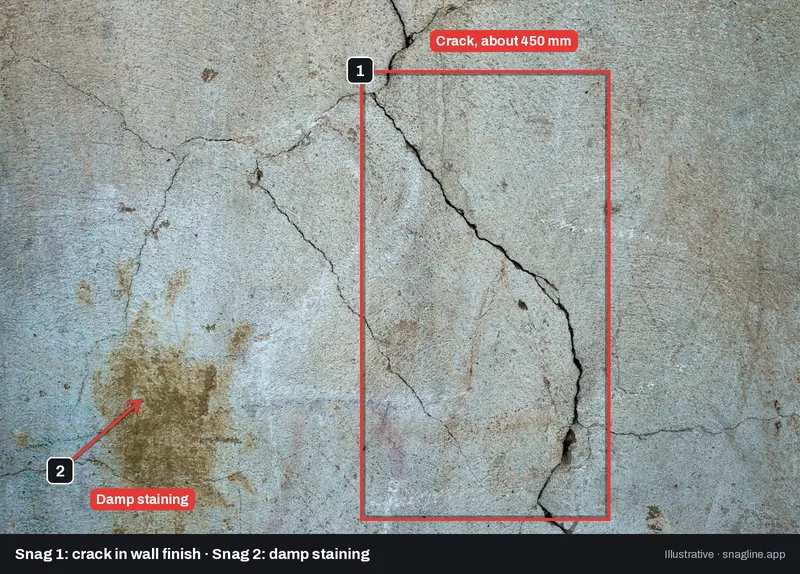
- a numbered list of items, each with the room, exact location, a description of what is wrong and at least one photo;
- for some items, the standard or regulation the work falls short of;
- notes on anything the inspector could not inspect (locked rooms, no loft access, services not connected).
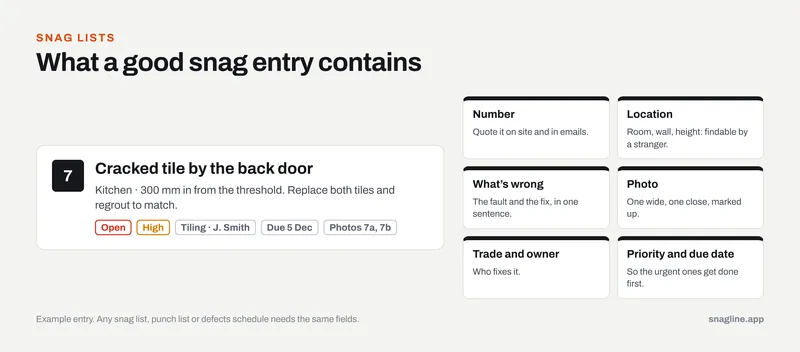
An item written well reads like this: "14. Bedroom 2, window wall: plaster crack approx. 300 mm running from corner of window reveal. Fill and redecorate." Vague entries ("cracks in bedroom") slow everything down. The pattern behind a good entry is in the figure below and in our guide to writing a snag list.
How much does a snagging survey cost?
Prices depend mainly on the size and type of the home, the region, the firm and the package (a standard inspection, or one that includes a re-inspection after repairs). As one dated example, the HomeOwners Alliance's partner service, New Build Inspections, advertised snagging surveys from £350 including VAT in November 2026, with the final price depending on property size and survey type, and a return inspection included only in its higher package.
What pushes the price up:
- more bedrooms and floors, or a detached house rather than a flat;
- extras such as thermal imaging or moisture testing;
- a re-inspection to check the developer's repairs;
- travel to remote sites.
Get two or three quotes for the same scope and compare what each includes, not just the headline price. A cheap inspection with a vague report can cost you more in chasing than it saved.
DIY snagging vs a professional snagging survey
| DIY | Professional snagging survey | |
|---|---|---|
| Cost | Free | A fee, varying with size, region and package |
| Time | Two to three hours for a typical house, plus writing up | The inspector's time; you receive a report |
| Standard used | Your own judgement and a checklist | Building regulations, warranty technical standards and the NHQB checklist |
| Loft and roof | Often skipped | Normally included where accessible |
| Report | Your own list and photos | Numbered report with photos, often with a summary |
| Weight with the developer | Depends on the clarity of your list | Generally taken seriously, especially if it cites standards |
| Best for | Flats, confident buyers, follow-up checks after moving in | Houses, first-time new build buyers, buyers who cannot attend in daylight |
Many buyers do both: a professional pre-completion inspection, then their own checks using the new build snagging checklist (Word, Excel and PDF in the download box above) during the two-year period.
How to choose a snagging company: questions to ask
Searching "snagging survey near me" gives you plenty of names. Narrow them down with these questions:
- Which professional body is the inspector a member of? Look for one of those named in the New Homes Quality Code, and check the membership on the body's own register.
- Do you hold professional indemnity insurance? Ask for the level of cover.
- Who will actually do the inspection? Some firms subcontract. Ask for the name and qualifications of the person attending.
- Will you use the NHQB Pre-Completion Inspection Checklist? This matters if your developer is registered with the Code.
- Can I see a sample report? Check that each item has a location, a description and a photo.
- What is included? Loft, roof, thermal imaging, re-inspection, help chasing the developer.
- How soon will I get the report, and in what format? PDF the same or next day is common.
- Can I attend? Being there lets you ask questions and learn what to watch for later.
Be wary of a firm that cannot name its professional body, will not show a sample report or promises a fixed number of findings.
After the survey: sending the report
- Read the report the day you get it and ask the inspector about anything unclear.
- Send it to the developer's after-sales or customer care team in writing, through their official channel, and keep the date.
- Track each item by its number. Under the New Homes Quality Code most after-sales issues should be resolved within 30 days; if a snag is not fixed within 30 days of reporting you can make a formal complaint.
- If repairs are disputed, a re-inspection gives you an independent view of whether they meet the standard.
For snagging inspectors: writing reports on a phone
If you carry out snagging inspections, Snagline is a phone app we are building for this work, iPhone first. You snap the issue, mark up the photo with arrows, boxes and labels, set the location, trade and priority, and drop numbered pins on the floor plan. The PDF report has a cover with your company details, logo and issue counts, and a sign-off with signature. It is not released yet; join the waitlist below.
Questions
Is a snagging survey worth it?
For many buyers, yes, especially for a house or a first new build. A professional checks against building regulations and warranty standards as well as finish, and usually finds items a buyer would miss, such as loft insulation or roof details.
How much does a snagging survey cost?
It depends on the size of the home, the region and the package. As one example, the HomeOwners Alliance's partner service advertised surveys from £350 including VAT in November 2026. Get two or three quotes for the same scope.
When should I get a new build snagging survey?
Ideally at the pre-completion inspection, after notice to complete and before legal completion. You can also book one after moving in, as long as it is within the developer's two-year after-sales period.
What qualifications should a snagger have?
For a pre-completion inspection under the New Homes Quality Code, membership of a recognised professional body such as RICS, RPSA, CABE, CIOB or ICWCI, plus professional indemnity insurance and use of the standard NHQB checklist.
Can the developer refuse my snagging inspector?
A developer registered with the New Homes Quality Code must give you the opportunity of a pre-completion inspection by a suitably qualified inspector. If your developer is not registered, check your contract and ask before booking.
How long does a snagging inspection take?
It varies with the size of the home and the firm. Ask when you book, and allow time to walk round with the inspector at the end if you attend.